

 Andy Crestodina quit his day job in 1999 with no real shot at the one he actually wanted, which was a web designer, so he started a tiny website-building company with a friend from high school who was also his college roommate. Twenty-five years later, that company is Orbit Media Studios, a 55-person B2B digital agency doing $9 million in revenue, built entirely on organic channels. Andy has never bought an ad.
I talked with him about what changed when Google started answering questions instead of sending clicks, why he built his own AI advisors instead of reading AI news, the specificity check he built to catch homepages that fail their own visitors, and the uneasy truth about which platforms want you to succeed.
How did Orbit Media start, and how has it grown over 25 years?
I just wanted to make stuff. I quit my job in 1999 because I just wanted to be a web designer. Weirdly, sometimes it’s easier to start a company than find a job. So I started a company building websites with a friend from high school (and my college roommate) Barrett Lombardo. We never looked back.
As the company grew, I knew I needed to understand SEO, conversion, visitor psychology, and analytics. Everything we do now is focused on driving demand for B2B brands. We believe a website should generate leads every single day rather than just sitting there. It should perform like a strong sales rep.
There’s one decision that’s shaped everything else: Our go-to-market strategy is strictly through organic channels. We do for ourselves exactly what we advocate for clients. We have never bought an ad. Twenty-five years in, we’re a 55-person agency doing $9 million in revenue. I’m just the guy who never pivoted. We just kept going.
What’s changed about how people find and consume content?
Big tech has been disrupting lead generation for a very long time, especially Google.
Marketers worry about zero-click queries, and from Google’s perspective, a click on your website is a zero-click query for them. They get nothing by sending you a qualified visitor who converts into a lead. There’s always been tension between Google and lead-gen marketers, and we’ve lived with it forever.
What’s different is how much Google has piled onto the results page since then:
- Featured snippets
- The “People Also Ask” box
- Video carousels
- More ads
- …and now the AI overview
I’ve tracked changes to SERPs (search engine results pages) for many years. It’s incredible to see how they’ve changed over time.
These have all landed on top of the ads that were already there. It’s wildly disruptive for brands that relied strictly on search to generate demand. There’s still a huge opportunity if you know what you’re doing, especially around key phrases where the results page isn’t slammed full of features and visual noise.
But the one thing that hasn’t changed is why people buy. Trust hasn’t changed. Human psychology hasn’t changed.
People in cybersecurity, or any category, are still deciding based on the same factors and the same psychology they have always had. So the smart move is to optimize for the human visitor and for sales (always has been).
Never make an unsupported claim. Answer every sales question. Go deep enough into a topic that you cover everything a visitor needs to see before they’ll act.
And it’s a strangely beautiful moment, because those exact things are what help AI understand what you do. SEO used to work off a narrow checklist of things that correlate with rankings. Now you have to genuinely answer real sales questions in your content, whether or not it looks anything like a keyword.
The average AI prompt runs about 25 words longer than the average search query. What’s in those 25 words? It’s the buyer telling the model about their challenges, their context, and what they’re afraid of.
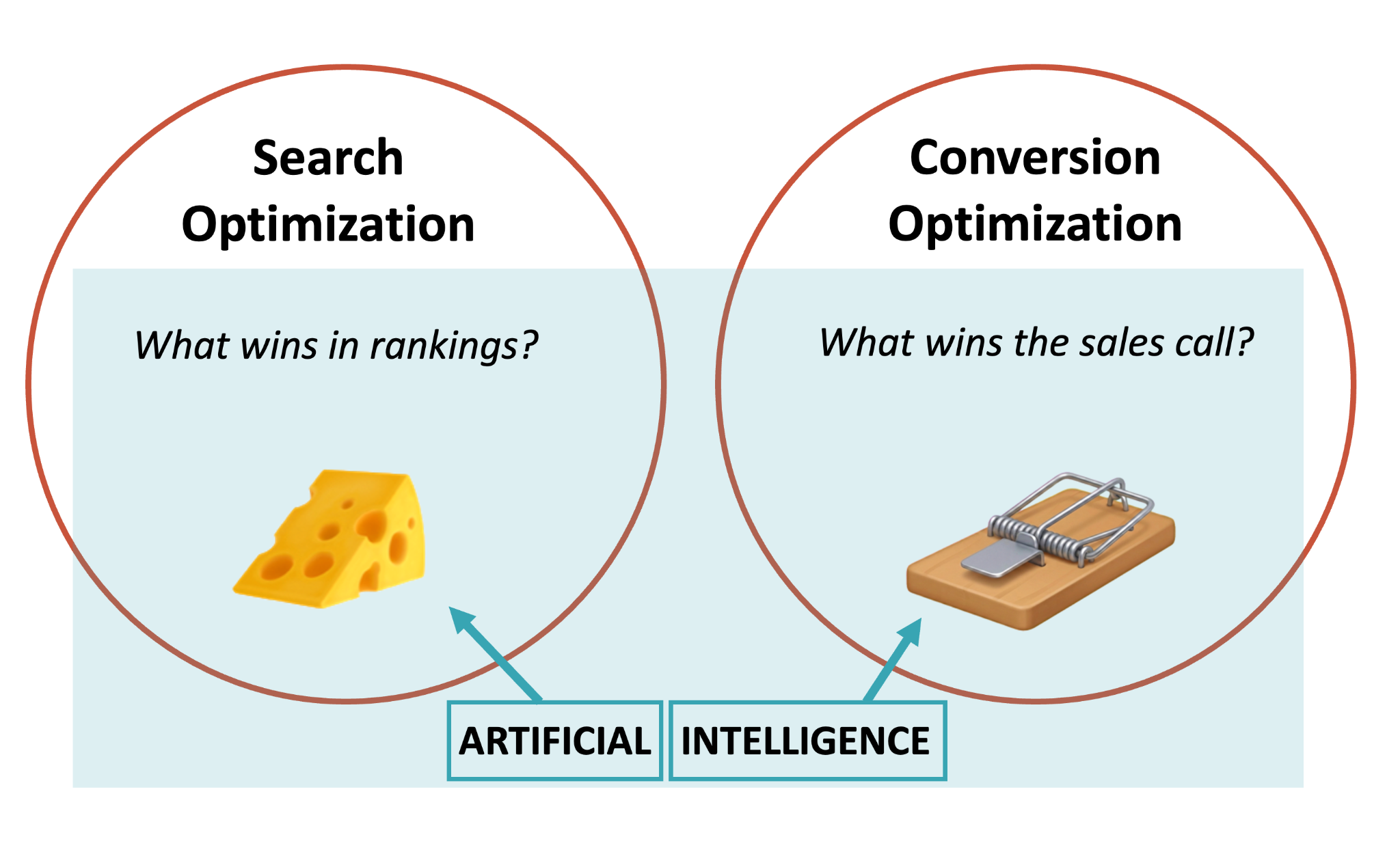
Search, conversion, and AI are meeting in the middle, and it’s fascinating to watch. There are real wins available just from writing better copy and aligning with the visitor, with real empathy.
How do you measure whether a content program is working?
The classic ways to measure are things a lot of marketers still aren’t that good at. Very few know the click-through rates on their own calls to action. A lot of people don’t understand how inherently inaccurate analytics can be if you’re not measuring at the URL level, or separating your content program’s landing pages from your money pages and sales pages.
But there’s a deeper problem underneath that. Accurate attribution is harder than it’s ever been, and a lot of what marketers do isn’t actually a performance marketing strategy; it’s a brand marketing strategy. You need to know, in the moment, which one you’re doing.
Brand marketing has poor attribution but real value in awareness and loyalty, and brand marketers have never expected perfect attribution. Performance marketing is when you build a page, buy an ad, and measure the result directly.
We’re moving into an era where brand marketers will be pretty comfortable with that trade-off, and performance marketers will be frustrated, because much of what happens now shows up as direct traffic, and performance marketers have never liked direct traffic as a channel.
Google Analytics itself is undercounting a huge amount. It only reports on website visits and visitor behavior, so it can’t tell you how AI views your site.
Say I open Claude on my phone, have a five-minute conversation about the best marketing podcast, it recommends one, and I click through. I show up in GA as a direct traffic visitor because I came from an app. That gap is enormous. I still need the basics, click-through rates on calls to action, conversion rates on specific landing pages, organic traffic trends, and keeping the content program separate from the money pages. I’ll never stop measuring that. But it only goes so far.
The tool I actually recommend for AI specifically is Cloudflare. It manages bot traffic for security reasons and, as a result, sees exactly which bots requested which pages. I have access to about 100 Cloudflare accounts, ran the numbers across all of them, and found that AI visits homepages 15 times more than any other page type. It’s off the chart.
If you want AI to know something about you, put it on your homepage.
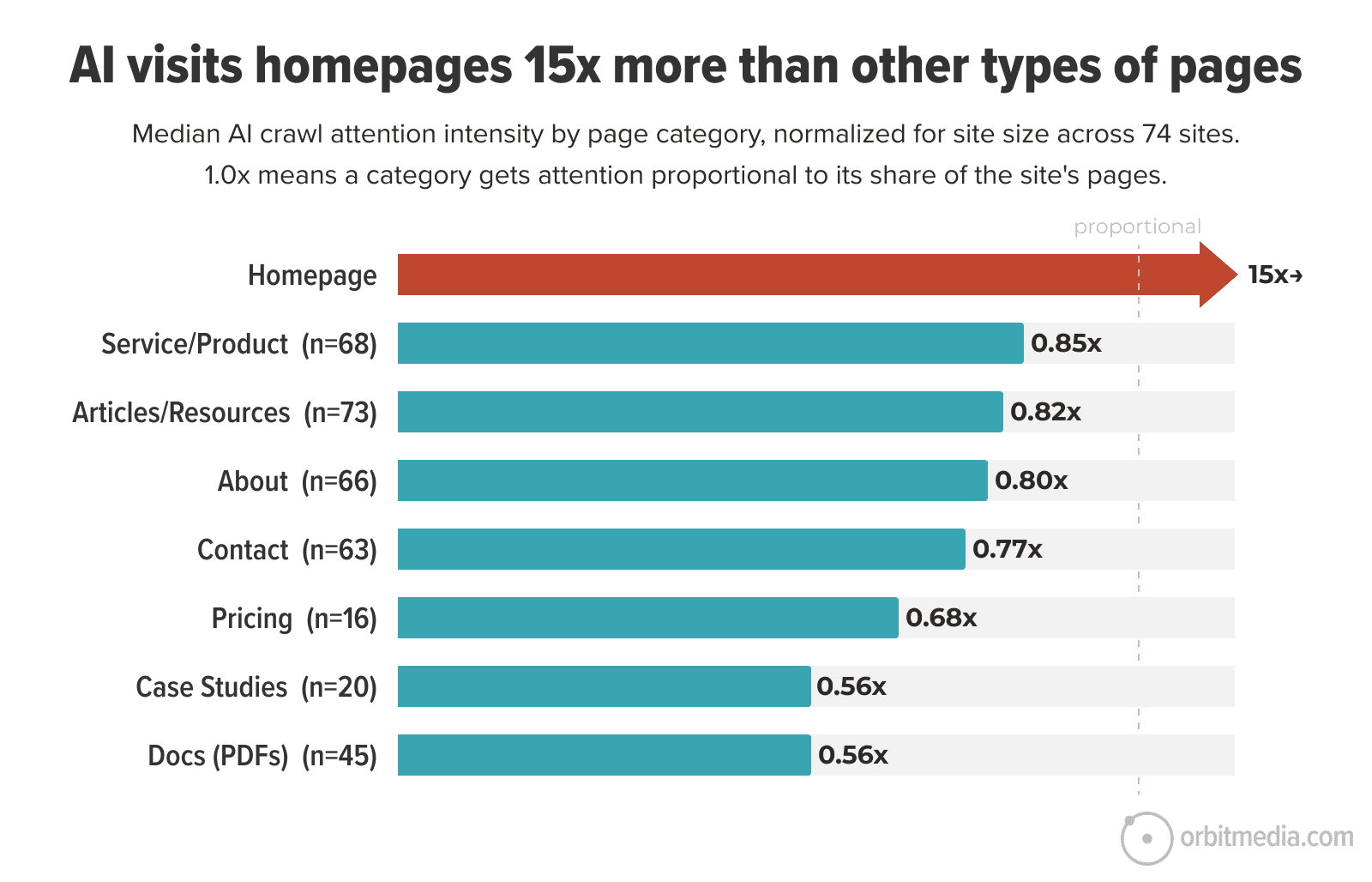
Image source: AI Crawl vs. Traffic Report, Orbit Media
Beyond that, anything that gets you closer to your actual buyer helps too, like click heat maps, tools like Microsoft Clarity, or watching session recordings. Most marketers have never watched one. Focus on the very human side of your site, and then try to understand how AI is learning about your brand. Those are the two reliable wins for anybody right now.
How do you stay sharp as a marketer when everything’s changing this fast?
I have the benefit of talking to companies every day, so conversations like this one keep me sharp. I hear what people’s challenges are.
But on the AI side specifically, I have a different approach. I don’t read AI news. It’s not helpful. Instead, if I have a challenge or an idea, I go talk to AI about it directly. I’ve built little AI advisors for myself, a GTM strategist, as a Claude project trained on a pile of interesting webinar transcripts and books.
AI is the most useful tool there is for learning how to use AI.
On the human side, I do regular one-on-one calls with people I know are running real experiments, testing new models, and combining tools in new ways. I’ve done AI masterminds and attended AI conferences, but only a small percentage of people are genuinely ahead and testing something new. Those are the people I learn the most from, and if they’ll have me, I’ll do a short call.
Half an hour trading notes on what I tried, what I found, and what they’re doing, and I walk away with a genuinely new idea. That’s a much faster way to learn than trying to read everything.
Clients tell you SEO and GEO need to be treated differently. Is that true?
Not really.
Put a prompt into any model, and you’ll see one of two things happen. It says “thinking,” then responds. Or it says “searching,” then responds. The ‘P’ in ChatGPT stands for pre-trained. It ingested a huge share of the internet, memorized a lot of things, and can answer plenty of simple prompts straight from that. Getting your data into that training data, making sure it has your best answers, is its own discipline.
But for longer prompts, more specific use cases, the kind of serious questions people ask in a category like cybersecurity, the model searches and retrieves information in real time, and that’s SEO.
You can see what it searched for. Once you look at that, you understand you still need your content to be keyword-focused, internally connected, and well supported. To this day, if you don’t have a page about something, it doesn’t really exist on the internet. That’s the SEO half. The retrieval and reasoning layered on top of it is the GEO half. Both are true at once, so I don’t think it’s useful to treat them as opposites.
What’s the real story on Reddit, and how do you know what’s influencing AI’s answers?
Most people haven’t fully embraced the simplest test available. Sit down for half an hour, pretend to be your own buyer, and have a real conversation with the AI. Keep asking it where it learned this, why it thinks that, what pages informed the response, and where the information is coming from. For most categories, Reddit barely shows up. People only believe Reddit matters because they haven’t had that conversation with the AI yet.
I’ve got a more rigorous version of this, too. I generate synthetic buyer prompts, run a sequence of them through Gemini, extract every source it used across that run, hand that list to Claude, and ask it to summarize where the model is learning about a category, cybersecurity, B2B agencies, whatever it is. Reddit is almost never in there.
A lot of the checklist advice circulating right now will stop working because it’s one-size-fits-all thinking applied to a channel that’s the opposite of one-size-fits-all. Everyone needs to be on Reddit. Everyone needs schema tags. Everyone needs FAQs. None of that comes from anyone thinking about who the buyer is, the story in their life, how they’re prompting, what they’re seeing in the responses, or where those responses came from.
I genuinely wince when B2B marketers in high-consideration categories bring up Reddit with total confidence. Show me the evidence. That’s the whole ask. Show me the evidence that Reddit is informing AI’s answers when your specific buyer is looking for help. That’s what we need right now, not more best practices.
What’s the fastest fix for a page that isn’t working?
A lot of pages fail for a painfully simple reason. They never explain what the company does. I built a prompt and eventually a Chrome extension on top of it that checks any page for specificity. You feed it the target buyer and the target key phrase, and it audits the page against that, flags anything vague, and improves it with one click.
Getting specific pays off in more than one direction at once. Google needs to understand your page through text to rank it well. AI needs to read your copy to learn what your value proposition is, since that’s the main way it learns about a brand at all, which makes updating your homepage one of the highest-leverage things you can do. And your human visitors need specificity to align with their own psychology, answer their real questions, and self-select in or out of your funnel. A specificity check catches most of that at once.
How should marketing and sales work together on attribution?
There are real gaps and silos between marketing and sales at most companies, and the most common complaint from sales is that the leads aren’t qualified.
The best CMOs are in lockstep with sales leadership, constantly talking about lead quality and who to target next. Attribution will never make everyone happy, but smart marketers get inside the CRM data.
If you only look at analytics, you’re measuring the marketing funnel, which isn’t actually why you have the job. The job is to drive demand, and understanding which leads are closing and why comes from the CRM, not the funnel.
A smart marketer doesn’t sit in on a sales call now and then. They download 50 sales call transcripts, analyze the language prospects use, and confirm the marketing content answers those exact questions.
That’s how you improve lead quality, by helping the wrong people disqualify themselves earlier rather than chasing every form fill. The goal was never to maximize form fills. It’s pipeline revenue. Marketers who aren’t accountable for that are at risk. Marketers who use sales calls and insights from sales leaders to improve their marketing are in a much safer spot.
I recommend building this directly into a Claude project. Take a hundred sales call transcripts, split them into two markdown files, one for closed-won calls and one for closed-lost calls, and add both as knowledge sources. Ask the project what actually separates those two groups, and what the top questions are.
That’s my forever complaint about SEO and FAQ sections, too. Most of them have no idea what the truly frequently asked questions are, because they never went anywhere near a sales call to find out. SEO considers the gap between their site and a competitor’s. Salespeople and conversion copywriters think about the gap between what they’re saying and what the buyer needs to hear. Those are two completely different points of view, and only one of them is grounded in what real buyers are asking.
What’s the uncomfortable truth about content marketing most people won’t say out loud?
SEO and social media marketers are algorithm marketers, and that means they’re forever beholden to big tech for their performance. If every one of your marketing strategies depends on an algorithm you don’t control, you’re not in a safe position.
SEO lives in a state of tension with Google. But YouTubers live in harmony with YouTube. LinkedIn publishers live in harmony with LinkedIn.
I lived this myself. I wrote search-optimized articles for fifteen years and eventually got close to a million readers a year that way. Then I watched Google start keeping more and more of its own traffic for itself, so I launched a LinkedIn newsletter instead. I now reach 3M+ readers a year through it.
LinkedIn and I are friends. They want my newsletter to succeed. Google never really wanted me to have a lot of free organic search traffic to begin with, even when I was playing by their rules.
That doesn’t mean abandoning your own site for whatever platform is friendliest this year. Keep your blog, keep your email list, keep publishing where you own the relationship. Treat LinkedIn as a syndication strategy sitting on top of that. It’s not a replacement for it.
The pages on your own site that already rank and already attract demand are still worth keeping around, no matter what else you’re doing. That kind of patience is what separates marketers who’ve been doing this for a long time from those who are new to the category.
Andy Crestodina co-founded Orbit Media Studios in 1999. The Chicago-based digital agency has grown to 55 people and $9 million in revenue on organic channels alone, without ever buying an ad. He writes and speaks widely on SEO, content strategy, and how AI search is changing B2B marketing.
ABOUT BORA
We’re Bora. We work with security companies to turn complex technical capabilities into clear, credible market narratives.
Get in touch for a free 30 minute consultation. If we’re not the right fit, we’ll help find someone who is.