
 Scott Purcell co-founded Man of Many, which Ipsos currently measures as Australia’s largest men’s lifestyle publisher. In September, the team released its 2026 Guide to GEO, a 65-page report where every figure carries a source and a date, including the ones that make Man of Many’s own AI numbers look small. It’s the third in a series that started with an issue called GEO is Mostly Bullshit, which gives you a fair idea of where Scott stands.
I talked with him about what the early AI search data got wrong, why the standalone chatbots deserve a sliver of budget at most, what happens to brands that flood the web with thin placements, and why the people selling GEO would rather you didn’t read the studies behind it.
What did you get wrong about AI search when you first started paying attention to it?
How much of the early data was noise. When we audited our own numbers in September, our tracker had AI agents at 0.88% of requests. The verified figure was 0.45%, about half that, because a lot of what shows up as ChatGPT or Perplexity traffic is ordinary bots using a fake user agent. Genuine AI referrals came to 0.41% of our sessions that month. The story about AI search is running well ahead of the data.
Most people meet AI answers inside Google, not ChatGPT. How much should marketers care about the standalone chatbots right now?
Some, but they shouldn’t get much of the budget. Google still handles 73.7% of US desktop searches, and SparkToro’s March data shows Amazon, Bing and YouTube each carry more search activity than ChatGPT. Rand Fishkin’s order of priority is about right. Start with AI Overviews for the keywords that matter to you, then the social accounts your audience follows, then the publications they read, with the chatbots a distant fourth.
Our own crawl data from September makes the same point. Google crawls about 1.4 of our pages for every visit it sends us. ChatGPT crawls 321. Watch the chatbots, but don’t build a strategy around them yet.
Most of what AI says about a brand comes from third-party sites, mainly reviews, comparisons and best-of lists. How should brands split their effort between their own content and earned coverage?
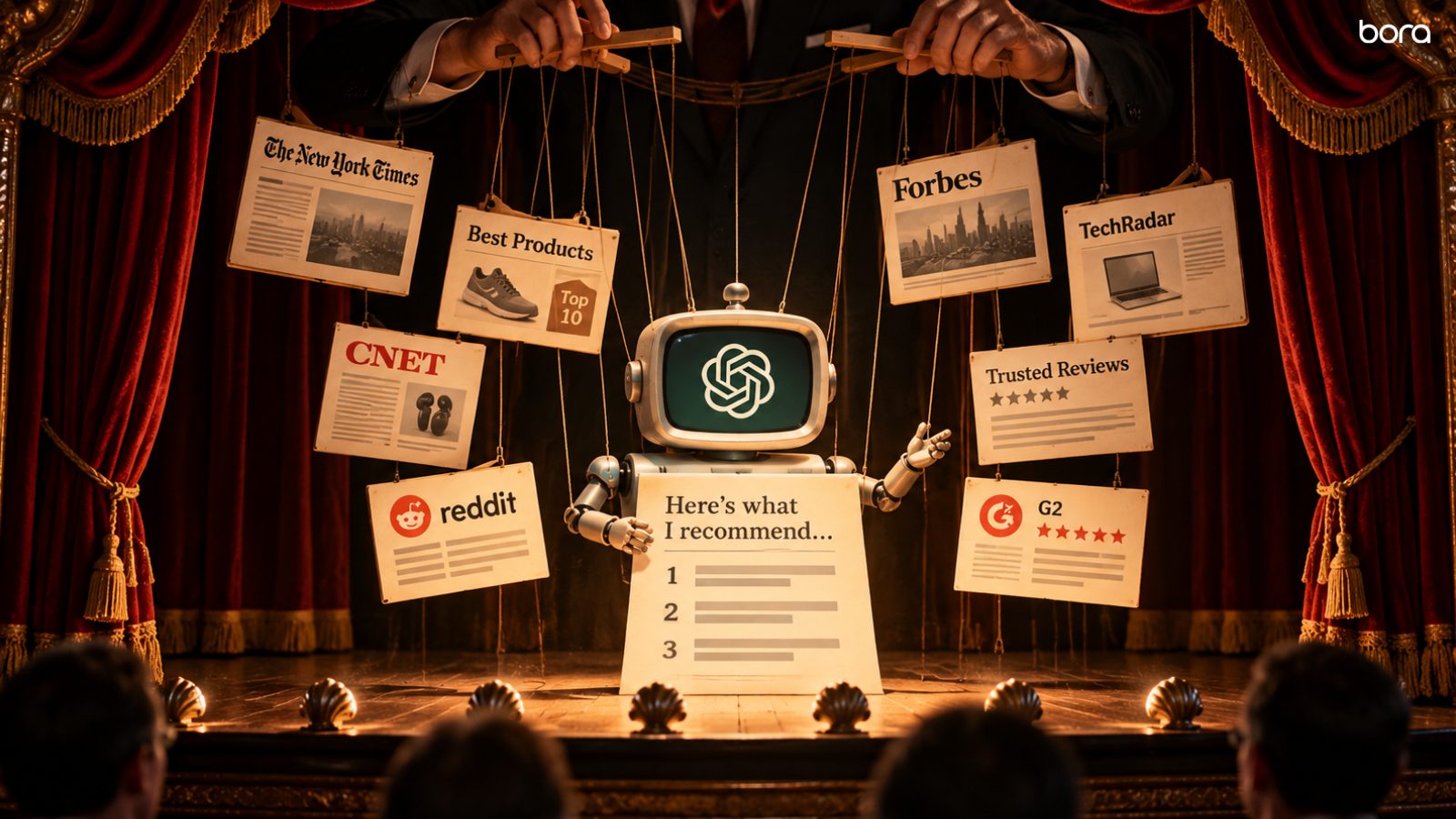
I’m a publisher, so take my bias into account, but the data is clear. AirOps looked at 21,311 brand mentions across ChatGPT, Claude and Perplexity last October. 85% came from third-party sites and only 13.2% from the brand’s own domain, and nearly 90% of those third-party mentions sat in listicles, comparisons and reviews.
Your own site still has to do the basics well, with clear product facts, pricing and straight answers to the questions buyers ask. Once that’s done, most of the extra effort belongs in coverage from publications your customers already trust. You build the foundations yourself, and you earn the rest.
If third-party content drives most AI mentions, what stops brands from flooding the web with thin placements? What happens when they try?
The same thing that happened in SEO. It works until it doesn’t. In May, Lily Ray at Amsive studied more than 220 sites that scaled up AI-generated content, and 54% of them lost 30% or more of their peak traffic.
The platforms can also cut a source off almost overnight. Semrush tracked Reddit’s share of ChatGPT citations falling from 3.8% to 0.5% between August 14 and 17 this year. If a dominant community source can be cut back in three days, a network of paid placements on sites nobody reads is exposed too. Thin placements are cheap to buy and just as cheap for a model to ignore.
Fresh content gets cited, but news coverage rarely stays cited. What kind of content keeps its place in AI answers?
Evergreen content that someone keeps maintaining. SISTRIX’s research on citation drift found news articles stay cited only 1.4% of the time, while category, comparison and review pages tend to anchor and stay.
Freshness still counts. AirOps found 35% of cited pages were under three months old, against 13% for pages nine months or older. So what works is a useful guide or comparison that gets a proper update whenever something changes. Putting a new date on the same page doesn’t count. A news hit gets you a week. A well-kept best-of page can hold its position for a year.
In B2B categories like cybersecurity, where buyers research for a long time, which sources do you think AI relies on most?
That’s outside our category, and I haven’t seen good data on it, so treat this as my view rather than a finding. I’d expect the same pattern as consumer, with third-party sources carrying the weight. In cybersecurity, that probably means analyst reports, peer review platforms, specialist trade press, practitioner communities, and detailed technical documentation.
A long research cycle means the buyer asks a lot of specific questions, so depth probably matters more than reach. But I’d want real citation data for that category before telling anyone where to spend.
Schema, llms.txt and mass-produced AI content have all been sold as ‘GEO tactics’. Which are a waste of money, and why do they keep selling?
All three, if you’re paying for them as citation tactics. Ahrefs looked at 1,885 pages in May and found AI Overview citations fell 4.6% after schema was added. SE Ranking found no relationship between llms.txt and AI citations across about 300,000 domains last November. Mass AI content is the Lily Ray finding I mentioned.
Schema still has uses in regular search, and an llms.txt costs nothing to host. The problem is charging a client for them as a way to get cited. They keep selling because they’re easy to explain, easy to deliver and easy to show on a report. “Be worth recommending and get covered by people your buyers trust” is a much harder retainer to sell.
The same prompt rarely returns the same answer twice, yet AI visibility dashboards are selling fast. Is there an honest way to measure AI visibility today?
Only roughly, and anyone promising a ranking is overselling it. In January, Rand Fishkin ran 2,961 queries with 600 volunteers and rarely got the same brand list twice. AirOps found only 21% of brands that were both cited and mentioned stayed visible across five or more runs of the same prompt.
The honest version is a fixed set of prompts you run many times, reporting how often you appear instead of what position you’re in. Then check that against things you can actually measure, like referral traffic, branded search, and sales. Use it to see which way you’re trending, and leave the scoreboard talk out of it.
Lists and comparison articles work today because models rely on them. Do you expect AI platforms to start discounting them, the way Google discounted keyword stuffing?
I expect them to discount bad lists. The format itself is safe, because people really do make decisions by comparing options, and a well-researched comparison is useful enough that the models will keep using it. The ones at risk are pay-to-play lists, vendors ranking themselves first on their own site, and lists where nobody tested anything. Google went down the same road with its reviews updates.
There’s also an incumbency effect forming. In July, Semrush mapped 1,094 AI topic categories and found only 15.2% have a clear owner, but once a source owns a category it keeps it 90.4% of the time month to month. A trusted list that already holds a category is hard to shift.
What’s the uncomfortable truth about GEO that most people selling it won’t say out loud?
Most of it is good SEO, good PR, and a product people actually want to recommend, with a new name and a bigger invoice. The spend is running well ahead of the proof. Chatbots send very little traffic, the measurement is shaky, and the tactics sold as GEO-specific mostly don’t move citations. What does work is being the brand that trusted third parties write about, and that was already true before anyone coined the acronym.
Scott Purcell is co-founder of Man of Many, the Sydney-based publisher that has covered men’s lifestyle since 2012 and was named Publishing Company of the Year at the 2026 Mumbrella Awards. Man of Many’s 2026 Guide to GEO is available at manofmany.com.
ABOUT BORA
We’re Bora. We work with security companies to turn complex technical capabilities into clear, credible market narratives.
Get in touch for a free 30 minute consultation. If we’re not the right fit, we’ll help find someone who is.